Top Shopify Apps for Automating Your Store
Stack Architect is featured here, where the free automation stack is recommended alongside the paid tools it replaces.

Luke Sandelands is a Shopify automation specialist and the founder of Stack Architect, which publishes free, open-source tools that replace paid Shopify apps. Every guide comes from hands-on implementation work: building Make.com scenarios, configuring Meta Conversions API and Google Enhanced Conversions, and testing each build in production stores before publishing.
The same architecture that Elevar charges $225/month for, and Triple Whale prices by store revenue, is released here free, with the full source on GitHub, step-by-step setup, and no upsell.
Built with
Press & contributions
Leaders Perception · August 2026
“The customer browser has become a hostile environment that is filled with ad blockers and tracking prevention protocols.”
Stack Architect's approach to replacing Shopify apps with server-side pipelines was covered by Leaders Perception in August 2026.
Stack Architect exists because of a pattern I kept seeing in the Shopify ecosystem: store owners paying $145–$650/month for server-side tracking tools that do little more than route a Shopify Order webhook through an automation platform. I built the first version of CAPI Shield myself (configuring the Meta Conversions API directly via Make.com) and it sends the same server-side events to Meta that the paid tools do, at $0.
That pattern repeated across every category. Inventory management. P&L reporting. TikTok Events API. Email automation. In every case, the paid app was charging monthly for configuration work that needs no code to replicate directly. So I documented all of it (step by step, with the exact API endpoints, field mappings, and Make.com scenario structures) and published it free.
The full source for every tool is public on GitHub, so nothing here is a black box. Anything I describe can be inspected, forked, and rebuilt independently, which is more than any of the paid alternatives offer.
Every number on this site is sourced or clearly framed. We publish no Event Match Quality figure, not a target, not an achieved score. We have never sampled EMQ across stores; what we state is which match keys an event carries, because that is a property of the payload and you can verify it. Savings figures are calculated against current Shopify App Store pricing, checked regularly. The 20–40% signal-loss estimate this site used to carry was retracted on 4 September 2026: no source behind it measured that quantity, and the loss is store-specific in any case: the full record is here. We publish no loss figure and no recovery percentage: we have no first-party measurement of either. No fabricated metrics. No purchased reviews. No manufactured social proof. If a number isn't backed by a source, it isn't here.
Stack Architect is featured here, where the free automation stack is recommended alongside the paid tools it replaces.
Treat cross-border localisation as an automation problem rather than a translation one.
Shared proven two-step intent strategies for Shopify pop-up forms.
The same prioritisation thinking that shapes how the tools and guides here are built and maintained.
When pipeline debt collides with new delivery demands, my rule is to require absolute technical determinism before model creation. Build the deterministic pipeline first and the model second, because a model sitting on a pipeline you cannot reason about produces outputs you cannot verify: the same failure mode the free stacks documented here are engineered to avoid.
Enterprise AI pilots fail for architectural reasons rather than political ones: generative models and agentic protocols like MCP are non-deterministic, and bolting them onto legacy REST APIs that assume explicit schemas and predictable state boundaries (with no intermediate validation or event-driven orchestration) breaks at the boundary layer, leaving an operator to hand-verify every output against a brittle database until that bottleneck destroys the ROI. The fix I put forward is replacing fragile polling and middleman APIs with event-driven pipelines that enforce schema validation at ingestion.
The primary margin killer in e-commerce is relying on third-party apps that inject bloated client-side code at the point of payment. Building checkout upsells natively using Shopify Checkout Extensibility shifts all targeting logic off the browser and onto the server. This keeps the transaction fast while eliminating the recurring monthly app fees that erode profit margins over time.
Checkout upsells belong in Shopify Checkout Extensibility, not in a third-party app that injects client-side code at the point of payment: the same server-side-first argument every blueprint on this site is built on.
Open-source & community. Stack Architect tools are listed in Awesome No-Code / Low-Code and Awesome Cloudflare, and the attribution-gap benchmark runs on an open-source Cloudflare Workers backend.
Every third-party price and platform fact is read on the vendor’s own page, recorded with the date, and shown on the page that uses it. When a vendor changes something, the page changes or says it no longer applies. Our method.
Optional ready-made blueprints and disclosed affiliate links. Every free guide works without buying anything, and a commission never decides a recommendation. Who runs it.
The guides on this site cover areas I implement hands-on. Here is an honest breakdown of what I build and test directly:
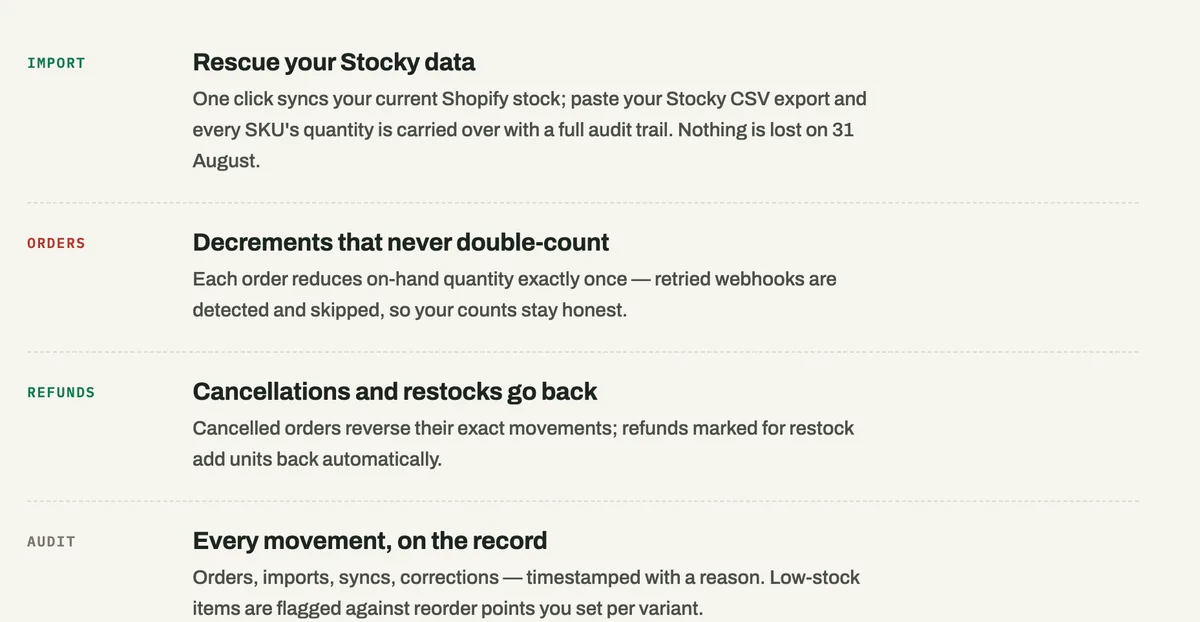
The clearest test of whether someone understands Shopify inventory is whether they can build for it. StockLog is my Shopify app: a persistent stock ledger that decrements on orders, restocks on cancellations and refunds, imports Stocky CSV exports ahead of the 31 August 2026 shutdown, and keeps a timestamped audit trail of every movement. Its Shopify App Store listing is dated August 2026, and it costs $7.99/month.
The live product at stocklog.onrender.com: every inventory guide on this site is informed by building it. How StockLog works, what it costs and what it doesn’t do.
Six free tools, 21 calculators, and a guide library covering every workflow in the free Shopify automation stack. All free forever, all open-source.
No code required. Every tool deploys via Make.com's free tier. No subscriptions, ever.
For deployment support, tool questions, or feedback. Most questions are already answered in the guides and FAQ, but if not, the support email is monitored daily.

shopify-capi-validator npm package. Builds Shopify server-side tracking, Meta CAPI and Google Apps Script automations. Quoted on server-side vs. app-based checkout tracking in MAKERSPACE, August 2026. Updated