Deep Dive: This article is part of our comprehensive tracking series. For how the paid attribution tools compare with the free server-side route, see Shopify attribution tools compared.
TL;DR: On 15 April 2026 Meta shipped a free, one-click Conversions API setup inside Events Manager. Turn it on today: it needs no code, costs nothing, and Meta’s April 2026 figure puts advertisers running CAPI on web events at a 17.8% lower cost per result. But know exactly what you switched on: a server-side mirror of your browser Pixel, for Meta only. The two failure modes it doesn’t fix (events the Pixel never fires, and every non-Meta platform) are the two that a free Shopify webhook setup exists to solve.
What Meta actually released
Meta announced two connected updates on 15 April 2026: an AI-enhanced Pixel that automatically enriches events with product names, prices, and availability, and the Meta-enabled Conversions API: a one-click path to server-side tracking where Meta hosts the infrastructure itself. No code, no server, no partner app, no maintenance.
Before this, “set up CAPI” meant choosing between a developer build, a partner integration (Shopify’s Facebook & Instagram channel), a CAPI Gateway container, or middleware like Stape. The one-click option adds a fourth path: Meta runs the server, you press a button. Deduplication is automatic: Meta inherits your Pixel’s event configuration and assigns matching event_id values so browser and server events merge instead of double-counting.
Meta’s framing was as notable as the feature: every advertiser should run Pixel and Conversions API together, with deduplication. The company quantified why, in that same April 2026 announcement: advertisers with CAPI on web events average 17.8% lower cost per result than those without.
How to activate it (2 minutes)
- Open Meta Events Manager and select your Pixel.
- On the Overview tab, find the “Activate Conversions API” button. Note: the default flow nudges you toward partner integrations, the Meta-enabled option sits one step deeper, so don’t stop at the Shopify partner card.
- Confirm the data-sharing settings. Meta stands up the server side and inherits your Pixel’s standard events.
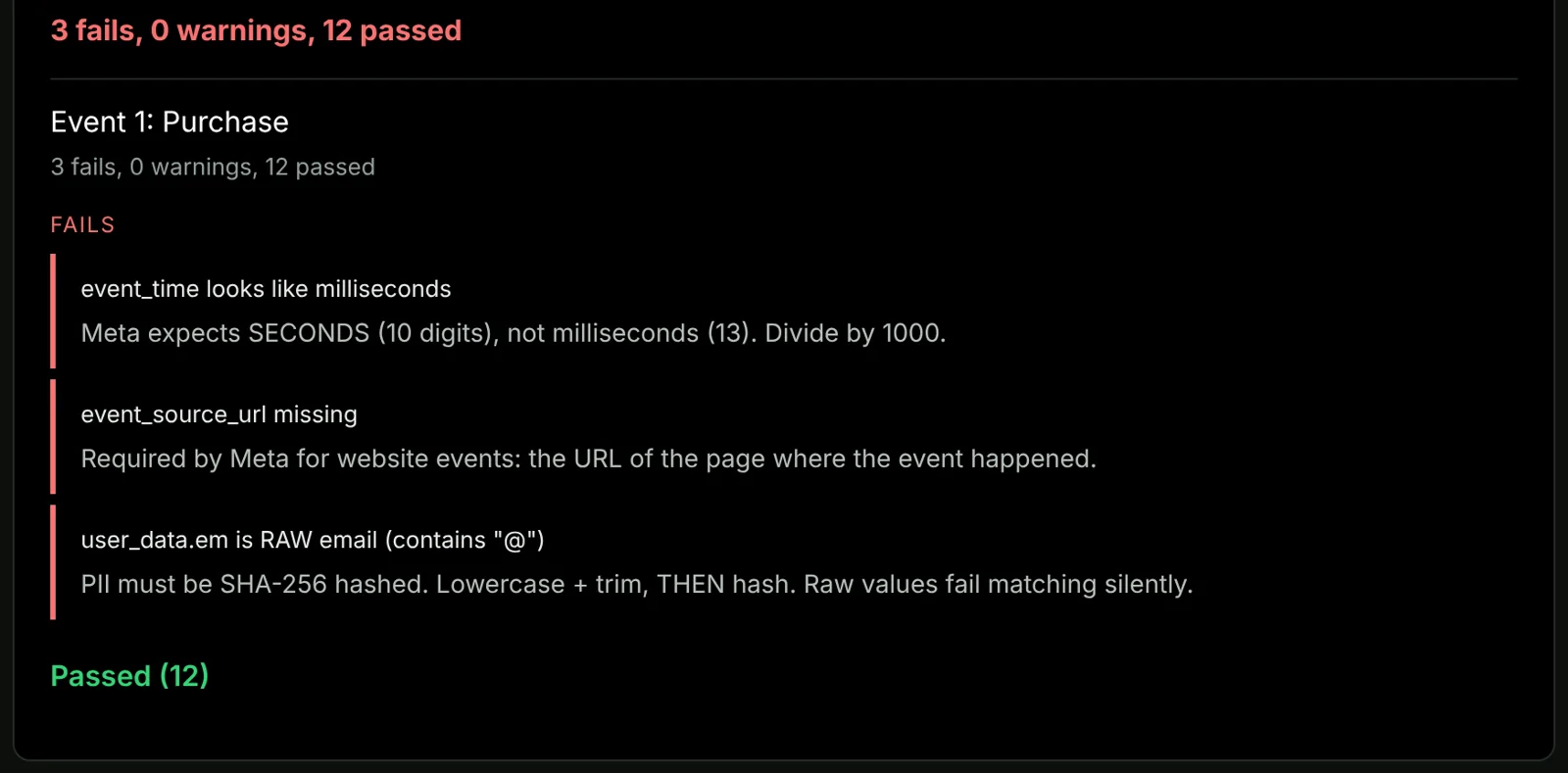
- Verify in the Test Events tab: place a test order and confirm the browser event and server event arrive with the same
event_idand show as Deduplicated. If they arrive as two separate rows, you don’t have working CAPI: you have double-counting.
Meta rolls features out gradually, so if the button isn’t visible on your account yet, check back within a few weeks.
The honest part: what it doesn’t fix
It mirrors the Pixel: it doesn’t replace it. The Meta-enabled CAPI creates a server-side connection to your Pixel data. When the Pixel fires, Meta now also receives the event server-side, immune to anything that happens after the browser sends it. But when the Pixel never fires at all: an ad blocker stripped the script, a strict content blocker on iOS 26 killed it, the customer closed the tab before the thank-you page finished loading: there is nothing to mirror. One-click CAPI recovers the portion where the Pixel fired but delivery failed, not the portion where the Pixel never ran, and how those two portions divide is a property of your store and its traffic, not something an industry figure can tell you.
That second portion is what a Shopify webhook fixes. Shopify’s orders/paid webhook fires from Shopify’s server the moment payment is confirmed: no browser, no script, no dependency on the customer’s device. That’s the architecture behind CAPI Shield: one Make.com scenario receives the webhook and posts the purchase server-to-server, with the same event_id deduplication, at $0/month on Make.com’s free tier (~250 orders/month at 4 credits per order).
It’s Meta-only. Google Enhanced Conversions and TikTok Events API are separate systems with their own endpoints. If you advertise on more than Meta, one-click CAPI covers one platform of three. The same webhook that feeds Meta can branch to Google and TikTok from a single trigger.
It’s standard events only. Custom events, offline conversions, CRM data, and subscription-lifecycle events are out of scope: Meta says so directly.
The decision in one table
| Your situation | Do this |
|---|---|
| Pixel-only tracking, Meta ads only | Turn on one-click CAPI today. Done for now. |
| Shopify native Facebook channel already on Maximum sharing | Keep it: it sends richer first-party identifiers than one-click. One-click is additive if you want it. |
| Advertising on Meta plus Google and/or TikTok | One-click covers Meta only. For TikTok, add the free webhook setup; for Google, turn on enhanced conversions in Shopify’s Google & YouTube app. |
| High ad-blocker / iOS-heavy audience and thank-you-page drop-offs | Webhook-origin events are the only fix; Pixel-derived CAPI can’t mirror an event that never fired. |
| Custom events, subscriptions, offline conversions | One-click can’t; this needs a custom or webhook-based implementation. |
| Paying $225+/mo for a managed tracking tool (Elevar’s Core plan on getelevar.com/pricing, read 25 September 2026) | One-click + the free webhook setup reach the same endpoints. The subscription buys dashboards and support, not better API access. |
Bottom line
Turn Meta’s one-click CAPI on: it’s a free upgrade with a performance figure Meta has published. Do not stack it on a second Meta server route, such as Shopify’s own Conversions API or a webhook scenario, or Meta can receive each purchase twice. Then close the two gaps it leaves. If you only advertise on Meta and your Pixel fires reliably, you may be done. If you spend on Google or TikTok too, or your audience skews iOS/ad-blocked, the webhook-based setup guide sends TikTok purchases from one Shopify webhook at $0/month, and enhanced conversions in the Google & YouTube app covers Google.
Facts verified 15 July 2026 against Meta’s 15 April 2026 announcement and independent reporting of the rollout. Meta’s 17.8% figure is Meta’s own measurement across advertisers using CAPI for web events.